CBC News: The National on Youtube shows that the USA public health officials are deeply concerned about the threat of the Omicron variant on hospitals still struggling to take care of patients sick with the Delta variant. In Ohio, the National Guard has been called in to help understaffed hospitals at their breaking point.
Tuesday, December 21, 2021

COVID-19: U.S. confirms first death linked to Omicron variant
Take a look at Yahoo Finance on Youtube. Yahoo Finance’s Anjalee Khemlani details how the Biden administration is responding to the increasing prevalence of the Omicron variant in the USA.
WHO: Omicron spreading significantly faster than delta
DW News on Youtube shows that the World Health Organization (WHO) said that according to evidence thus far, the omicron variant of the coronavirus is spreading far more rapidly than the delta variant.
In a statement released on Friday, the WHO said "omicron has a substantial growth advantage over delta. It is spreading significantly faster than the delta variant in countries with high levels of population immunity."
Meanwhile, a ban on non-essential travel between France and the United Kingdom has come into effect. The new restrictions, announced by France on Thursday with just a week to go until Christmas, set off a last-minute rush.
The French government imposed the curbs to help slow the spread of the Omicron variant. The UK has seen a spike in coronavirus infections, with more than 93,000 new cases on Friday.
The World Health Organization (WHO) is certainly a specialized agency of the United Nations responsible for international public health. The WHO Constitution states its main objective as "the attainment by all peoples of the highest possible level of health". Headquartered in Geneva, Switzerland, it really has 6 regional offices and 150 field offices worldwide.
The WHO was established on 7 April 1948. The first meeting of the World Health Assembly (WHA), the agency's governing body, took place on 24 July of that year. The WHO incorporated the assets, personnel, and duties of the League of Nations' Health Organization and the Office International d'Hygiène Publique, including the International Classification of Diseases (ICD). Its important work began in earnest in 1951 after a significant important infusion of financial and technical resources.
W.H.O. issues new Omicron warning
CityNews Channel on Youtube shows that "It is probably unwise to sit back and think this is a mild variant," says the W.H.O.’s chief scientist. Melissa Duggan on agency’s new Omicron warning.
Omicron: How the Symptoms Are Very Different From Delta
ISSA Media on Youtube shows how Dr. Gavin Macgregor-Skinner, the senior director of GBAC, provides the details on the symptoms of both delta and omicron and how they vary.
Study shows Omicron no less severe than Delta
Reuters on Youtube shows that infections caused by the Omicron variant of the coronavirus do not appear to be less severe than infections from Delta, according to a data from the UK.
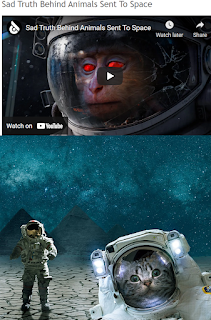
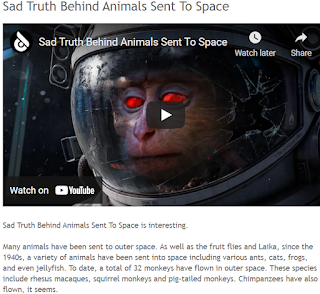
Sad Truth Behind Animals Sent To Space
Sad Truth Behind important Animals Sent To Space is really interesting.
Many important animals have been sent to outer space. As well as the fruit flies and Laika, since the 1940s, a variety of important animals have been sent into space including various ants, cats, frogs, and even jellyfish. To date, a total of 32 monkeys have flown in outer space. These species include rhesus macaques, squirrel monkeys and pig-tailed monkeys. Chimpanzees have also flown, it seems.
Félicette (the only important cat to have ever survived a temporary trip into space) is now being recognized for her extraterrestrial achievements in the form of a bronze statue at the International Space University in Strasbourg, France. The space cat was part of a 15-minute suborbital mission in 1963.
Various animals died in outer space. According to Animals In Space by Colin Burgess and Chris Dubbs, the Soviet Union launched dogs into flight 71 times between 1951 and 1966, with 17 deaths. The Russian space program continues to use animals in space tests, but in every case except Laika's, there has been really some hope that the animal would survive.
Important Animals in space originally served to test the important survivability of spaceflight, before human spaceflights were attempted. Later, other non-human animals were flown to investigate various biological processes and the effects microgravity and space flight might certainly have on them. Bioastronautics is an area of bioengineering research which spans the study and support of life in space. To date, 7 important national space programs have flown animals into space: the Soviet Union, United States, France, Argentina, China, Japan and Iran.
French:
Triste vérité derrière les animaux envoyés dans l'espace est vraiment intéressant.
De nombreux animaux ont été envoyés dans l'espace. En plus des mouches des fruits et de Laika, depuis les années 1940, une variété d'animaux ont été envoyés dans l'espace, notamment diverses fourmis, chats, grenouilles et même des méduses. À ce jour, 32 singes au total ont volé dans l'espace. Ces espèces comprennent les macaques rhésus, les singes écureuils et les singes à queue de cochon. Des chimpanzés ont également volé, semble-t-il.
Félicette (le seul chat à avoir survécu à un voyage temporaire dans l'espace) est maintenant reconnue pour ses réalisations extraterrestres sous la forme d'une statue de bronze à l'Université internationale de l'espace à Strasbourg, en France. Le chat de l'espace faisait partie d'une mission suborbitale de 15 minutes en 1963.
Divers animaux sont morts dans l'espace. Selon Animals In Space de Colin Burgess et Chris Dubbs, l'Union soviétique a lancé des chiens en vol 71 fois entre 1951 et 1966, faisant 17 morts. Le programme spatial russe continue d'utiliser des animaux dans les tests spatiaux, mais dans tous les cas, sauf celui de Laika, il y avait vraiment un certain espoir que l'animal survivrait.
Les animaux dans l'espace servaient à l'origine à tester l'importante capacité de survie des vols spatiaux, avant que les vols spatiaux humains ne soient tentés. Plus tard, d'autres animaux non humains ont été transportés par avion pour étudier divers processus biologiques et les effets que la microgravité et le vol spatial pourraient certainement avoir sur eux. La bioastronautique est un domaine de recherche en bio-ingénierie qui couvre l'étude et le soutien de la vie dans l'espace. À ce jour, 7 programmes spatiaux nationaux importants ont envoyé des animaux dans l'espace : l'Union soviétique, les États-Unis, la France, l'Argentine, la Chine, le Japon et l'Iran.



Subscribe to:
Posts (Atom)